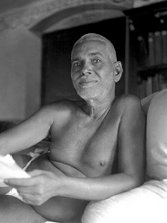
Sri Ramana Maharshi
This essay, composed by Bhagavan in the mid-1920s, is the work that originated with answers written in the sand in 1901. For many years it was the standard introduction to Bhagavan's teachings. Its publication was subsidised and copies in many languages were always available in the ashram's bookstore, enabling new visitors to acquaint themselves with Bhagavan's practical advice.
Although it continues to be a standard primer for those who want to know what Bhagavan taught, parts of Who Am I? are quite technical. Since Sivaprakasam Pillai, the devotee who asked the questions in 1901, was well acquainted with philosophical terminology, Bhagavan freely used technical terms in many of his answers. I have explained many of these in notes that alternate with the text. The words of the original essay are printed in bold type. Everything else is my own commentary or explanation.
Since these explanations were originally answers to Sivaprakasam Pillai's questions, I have included some of the original questions in my own notes. Before each new section of Who am I? begins, I give, if possible, the question that prompted it. Towards the end of the essay Bhagavan took portions from different answers and amalgamated them into single paragraphs, making it hard to know for sure whether he is answering a particular question or merely giving a teaching statement.
The paragraph that begins the essay was not given out in response to a question. It was composed by Bhagavan when he was rewriting the work in the 1920s. Many philosophical works begin with a statement about the nature of happiness and the means by which it can be attained or discovered. Bhagavan has followed this tradition in this presentation
Every living being longs to be perpetually happy, without any misery. Since in everyone the highest love is alone felt for oneself, and since happiness alone is the cause of love, in order to attain that happiness, which is one's real nature and which is experienced daily in the mindless state of deep sleep, it is necessary to know oneself. To achieve that, enquiry in the form 'Who am I?' is the foremost means.
Question: Who am I?
'Who am I?' The physical body, composed of the seven dhatus, is not 'I'. The five sense organs… and the five types of perception known through the senses… are not 'I'. The five parts of the body which act… and their functions… are not 'I'. The five vital airs such as prana, which perform the five vital functions such as respiration, are not 'I'. Even the mind that thinks is not 'I'. In the state of deep sleep vishaya vasanas remain. Devoid of sensory knowledge and activity, even this [state] is not 'I'. After negating all of the above as 'not I, not I', the knowledge that alone remains is itself 'I'. The nature of knowledge is sat-chit-ananda [being-consciousness-bliss].
Vasanas is a key word in Who am I? It can be defined as, 'the impressions of anything remaining unconsciously in the mind; the present consciousness of past perceptions; knowledge derived from memory; latent tendencies formed by former actions, thoughts and speech.' It is usually rendered in English as 'latent tendencies'. Vishaya vasanas are those latent mental tendencies that impel one to indulge in knowledge or perceptions derived from the five senses. In a broader context it may also include indulging in any mental activity such as daydreaming or fantasizing, where the content of the thoughts is derived from past habits or desires.
The seven dhatus are chyle, blood, flesh, fat, marrow, bone and semen. The five sense organs are the ears, skin, eyes, tongue and nose, and the five types of perception or knowledge, called vishayas, are sound, touch, sight, taste and smell. The five parts of the body that act are the mouth, the legs, the hands, the anus, and the genitals and their functions are speaking, walking, giving, excreting and enjoying. All the items on these lists are included in the original text. I have relegated them to this explanatory note to facilitate easy reading.
The five vital airs (prana vayus) are not listed in the original text. They are responsible for maintaining the health of the body. They convert inhaled air and ingested food into the energy required for the healthy and harmonious functioning of the body.
This paragraph of Who am I? has an interesting history. Sivaprakasam Pillai's original question was 'Who am I?', the first three words of the paragraph. Bhagavan's reply, which can be found at the end of the paragraph, was 'Knowledge itself is ''I''. The nature of knowledge is sat-chit-ananda.' Everything else in this paragraph was interpolated later by Sivaprakasam Pillai prior to the first publication of the question-and-answer version of the text in 1923. The word that is translated as 'knowledge' is the Tamil equivalent of 'jnana'. So, the answer to that original question 'Who am I?' is, 'Jnana is ''I'' and the nature of jnana is sat-chit-ananda'.
When Bhagavan saw the printed text he exclaimed, 'I did not give this extra portion. How did it find a place here?'
He was told that Sivaprakasam Pillai had added the additional information, including all the long lists of physical organs and their functions, in order to help him understand the answer more clearly. When Bhagavan wrote the Who Am I? answers in an essay form, he retained these interpolations but had the printer mark the original answer in bold type so that devotees could distinguish between the two.
This interpolation does not give a correct rendering of Bhagavan's teachings on self-enquiry. In the following exchange(1) Bhagavan explains how self-enquiry should be done, and why the 'not I, not I' approach is an unproductive one:
Q: I begin to ask myself 'Who am I?', eliminate the body as not 'I', the breath as not 'I', and I am not able to proceed further.
B: Well, that is as far as the intellect can go. Your process is only intellectual. Indeed, all the scriptures mention the process only to guide the seeker to know the truth. The truth cannot be directly pointed at. Hence, this intellectual process.
You see, the one who eliminates the 'not I' cannot eliminate the 'I'. To say 'I am not this' or 'I am that' there must be an 'I'. This 'I' is only the ego or the 'I'-thought. After the rising up of this 'I'-thought, all other thoughts arise. The 'I'-thought is therefore the root thought. If the root is pulled out all others are at the same time uprooted. Therefore, seek the root 'I', question yourself 'Who am I?' Find the source and then all these other ideas will vanish and the pure Self will remain.
Question: Will there be realization of the Self even while the world is there, and taken to be real?
If the mind, which is the cause of all knowledge and all actions, subsides, the perception of the world will cease. [If one perceives a rope, imagining it to be a snake] perception of the rope, which is the substratum, will not occur unless the perception of the snake, which has been superimposed on it, goes. Similarly, the perception of one's real nature, the substratum, will not be obtained unless the perception of the world, which is a superimposition, ceases.
Question: What is the nature of the mind?
That which is called 'mind', which projects all thoughts, is an awesome power existing within the Self, one's real nature. If we discard all thoughts and look [to see what remains when there are no thoughts, it will be found that] there is no such entity as mind remaining separate [from those thoughts]. Therefore, thought itself is the nature of the mind. There is no such thing as 'the world' independent of thoughts. There are no thoughts in deep sleep, and there is no world. In waking and dream there are thoughts, and there is also the world. Just as a spider emits the thread of a web from within itself and withdraws it again into itself, in the same way the mind projects the world from within itself and later reabsorbs it into itself. When the mind emanates from the Self, the world appears. Consequently, when the world appears, the Self is not seen, and when the Self appears or shines, the world will not appear.
If one goes on examining the nature of the mind, it will finally be discovered that [what was taken to be] the mind is really only one's self. That which is called one's self is really Atman, one's real nature. The mind always depends for its existence on something tangible. It cannot subsist by itself. It is the mind that is called sukshma sarira [the subtle body] or jiva [the soul].
Question: What is the path of enquiry for understanding the nature of the mind?
That which arises in the physical body as 'I' is the mind. If one enquires, 'In what place in the body does this ''I'' first arise?' it will be known to be in the hridayam. That is the birthplace of the mind. Even if one incessantly thinks 'I, I', it will lead to that place. Of all thoughts that arise in the mind, the thought 'I' is the first one. It is only after the rise of this [thought] that other thoughts arise. It is only after the first personal pronoun arises that the second and third personal pronouns appear. Without the first person, the second and third persons cannot exist.
Hridayam is usually translated as 'Heart', but it has no connection with the physical heart. Bhagavan used it as a synonym for the Self, pointing out on several occasions that it could be split up into two parts, hrit and ayam, which together mean, 'this is the centre'. Sometimes he would say that the 'I'-thought arises from the hridayam and eventually subsides there again. He would also sometimes indicate that the spiritual Heart was inside the body on the right aside of the chest, but he would often qualify this by saying that this was only true from the standpoint of those who identified themselves with a body. For a jnani, one who has realised the Self, the hridayam or Heart is not located anywhere, or even everywhere, because it is beyond all spatial concepts. The following answer (2) summarises Bhagavan's views on this matter:
I ask you to see where the 'I' arises in your body, but it is not really quite true to say that the 'I' rises from and merges on the right side of the chest. The Heart is another name for the reality, and it is neither inside nor outside the body. There can be no in or out for it since it alone is… so long as one identifies with the body and thinks that he is in the body, he is advised to see where in the body the 'I'-thought rises and merges again.
A hint of this can also be found in this paragraph of Who am I? in the sentence in which Bhagavan asks devotees to enquire 'In what place in the body does this ''I'' first arise?'
Ordinarily, idam, which is translated here as 'place', means only that, but Bhagavan often gave it a broader meaning by using it to signify the state of the Self. Later in the essay, for example, he writes, 'The place [idam] where even the slightest trace of ''I'' does not exist is swarupa [one's real nature]'.
Sadhu Natanananda, on the flyleaf of his Tamil work Sri Ramana Darshanam, records a similar statement from Bhagavan: 'Those who resort to this place [idam] will obtain Atma-jnana automatically.' Clearly, he cannot be speaking of the physical environment of his ashram because paying a visit there didn't necessarily result in enlightenment.
So, when Bhagavan writes 'In what place…' he is not necessarily indicating that one should look for the 'I' in a particular location. He is instead saying that that the 'I' rises from the dimensionless Self, and that one should seek its source there.
As he once told Kapali Sastri, (3) 'You should try to have rather than locate the experience'.
Question: How will the mind become quiescent?
The mind will only subside by means of the enquiry 'Who am I?' The thought 'Who am I?', destroying all other thoughts, will itself be finally destroyed like the stick used for stirring the funeral pyre.
Question: What is the means for constantly holding on to the thought 'Who am I?' And what is jnana drishti?
If other thoughts arise, one should, without attempting to complete them, enquire, 'To whom did they occur?' What does it matter if ever so many thoughts arise? At the very moment that each thought rises, if one vigilantly enquires 'To whom did this appear?' it will be known 'To me'. If one then enquires 'Who am I?' the mind will turn back to its source and the thought that had arisen will also subside. By repeatedly practising in this way, the mind will increasingly acquire the power to abide at its source. When the mind, which is subtle, is externalised via the brain and the sense organs, names and forms, which are material, appear. When it abides in the Heart, names and forms disappear. Keeping the mind in the Heart, not allowing it to go out, is called 'facing the Self' or 'facing inwards'. Allowing it to go out from the Heart is termed 'facing outwards' When the mind abides in the Heart in this way, the 'I', the root of all thoughts, [vanishes]. Having vanished, the ever-existing Self alone will shine. The state where not even the slightest trace of the thought 'I' remains is alone swarupa [one's real nature]. This alone is called mauna [silence]. Being still in this way can alone be called jnana drishti [seeing through true knowledge]. Making the mind subside into the Self is 'being still'. On the other hand, knowing the thoughts of others, knowing the three times [past present and future] and knowing events in distant places - these can never be jnana drishti.
The word swarupa is another key word in the text. It means 'one's real nature' or 'one's real form'. Each time the phrase 'one's real nature' appears in this text, it is a translation of swarupa. Bhagavan's repeated use of the word as a synonym for the Self indicates that the Self is not something that is reached or attained. Rather, it is what one really is, and what one always has been.
Mauna is another of the synonyms Bhagavan used to describe the Self:
Q: What is mauna [silence]?
A: That state which transcends speech and thought is mauna…. That which is, is mauna. Sages say that the state in which the thought 'I' does not rise even in the least, alone is swarupa, which means mauna. That silent Self is alone God…(4)
In jnana, the state of Self-knowledge or Self-realisation, there is no one who sees, nor are there objects that are seen. There is only seeing. The seeing that takes place in this state, called jnana drishti, is both true seeing and true knowing. It is therefore called 'seeing through true knowledge'.
In Day by Day with Bhagavan (17.10.46) Bhagavan points out that this seeing is really being and should not be confused with or limited to the sensory activity that goes under the same name: 'You are the Self. You exist always. Nothing more can be predicated of the Self than it exists. Seeing God or the Self is only being God or your Self. Seeing is being.' The same concept was elegantly formulated by Meister Eckart, the medieval German mystic, when he remarked, during one of his sermons, 'The eye by which I see God is the same eye by which God sees me. My eye and God's eye are one and the same, one in seeing, one in knowing…'
Question: What is the nature of the Self?
The Self, one's real nature, alone exists and is real. The world, the soul and God are superimpositions on it like [the illusory appearance of] silver in mother-of-pearl. These three appear and disappear simultaneously. Self itself is the world; Self itself is the 'I'; Self itself is God; all is Siva, the Self.
At the beginning of this paragraph Bhagavan says, in effect, that the world, the soul and God are illusory appearances. Later he says that all three are the Self, and therefore real. This should be seen as a paradox rather than a contradiction. The following answer (5) clarifies Bhagavan's views:
Sankara was criticised for his views on maya [illusion] without understanding him. He said that (1) Brahman [the Self] is real (2) the universe is unreal, and (3) Brahman is the universe. He did not stop at the second because the third explains the other two. It signifies that the universe is real if perceived as the Self and unreal if perceived as apart from the Self. Hence maya and reality are one and the same.
The seeing of names and forms is a misperception because, in the Self, the one reality, none exist. Therefore, if a world of names and forms is seen, it must necessarily be an illusory one. Bhagavan explains this in verse 49 of Guru Vachaka Kovai:
Just as fire is obscured by smoke, the shining light of consciousness is obscured by the assemblage of names and forms. When, by compassionate divine grace, the mind becomes clear, the nature of the world will be known to be not illusory forms, but only the reality.
Question: Are there any other means for making the mind quiescent?
To make the mind subside, there is no adequate means except enquiry. If controlled by other means, the mind will remain in an apparent state of subsidence, but will rise again. For example, through pranayama [breath control] the mind will subside. However, the mind will remain controlled only as long as the prana [see the following note] is controlled. When the prana comes out, the mind will also come out and wander under the influence of vasanas. The source of the mind and the prana is one and the same. Thought itself is the nature of the mind, and the thought 'I' which indeed is the mind's primal thought, is itself the ahankara [the ego]. From where the ego originates, from there alone the breath also rises. Therefore, when the mind subsides, the prana will also subside, and when prana subsides, the mind will also subside. However, although the mind subsides in deep sleep, the prana does not subside. It is arranged in this way as a divine plan for the protection of the body and so that others do not take the body to be dead. When the mind subsides in the waking state and in samadhi, the prana also subsides. The prana is the gross form of the mind. Until the time of death, the mind retains the prana in the body. When the body dies, the mind forcibly carries away the prana. Therefore, pranayama is only an aid for controlling the mind; it will not bring about its destruction.
According to the Upanishads, prana is the principle of life and consciousness. It is the life breath of all the beings in the universe. They are born through it, live by it, and when they die, their individual prana dissolves into the cosmic prana. Prana is usually translated as 'breath' or 'vital breath', but this is only one of many of its manifestations in the human body. It is absorbed by both breathing and eating and by the prana vayus (mentioned earlier) into energy that sustains the body. Since it is assimilated through breathing, it is widely held that one can control the prana in the body by controlling the breathing.
According to yoga philosophy, and other schools of thought agree, mind and prana are intimately connected. The collective name for all the mental faculties is chitta, which is divided into:
(a) manas (the mind), which has the faculties of attention and choosing.
(b) buddhi (the intellect), which reasons and determines distinctions.
(c) ahankara, the individual feeling of 'I', sometimes merely translated as ego.
Chitta, according to yoga philosophy, is propelled by prana and vasanas and moves in the direction of whichever force is more powerful. Thus, the yogis maintain that by controlling the breath, which indirectly controls the flow of pranas, the chitta can be controlled. Bhagavan gives his own views on this later in the essay.
The reference to samadhi needs some explanation. According to Bhagavan,(6) 'Samadhi is the state in which the unbroken experience of existence is attained by the still mind.'
Elsewhere he has said, more simply, 'Holding onto reality is samadhi.' (7)
Though Bhagavan would sometimes say that a person in samadhi is experiencing the Self, these samadhis do not constitute permanent realisation. They are temporary states in which the mind is either completely still or in abeyance.
source:http://davidgodman.org/rteach/whoami1.shtml


